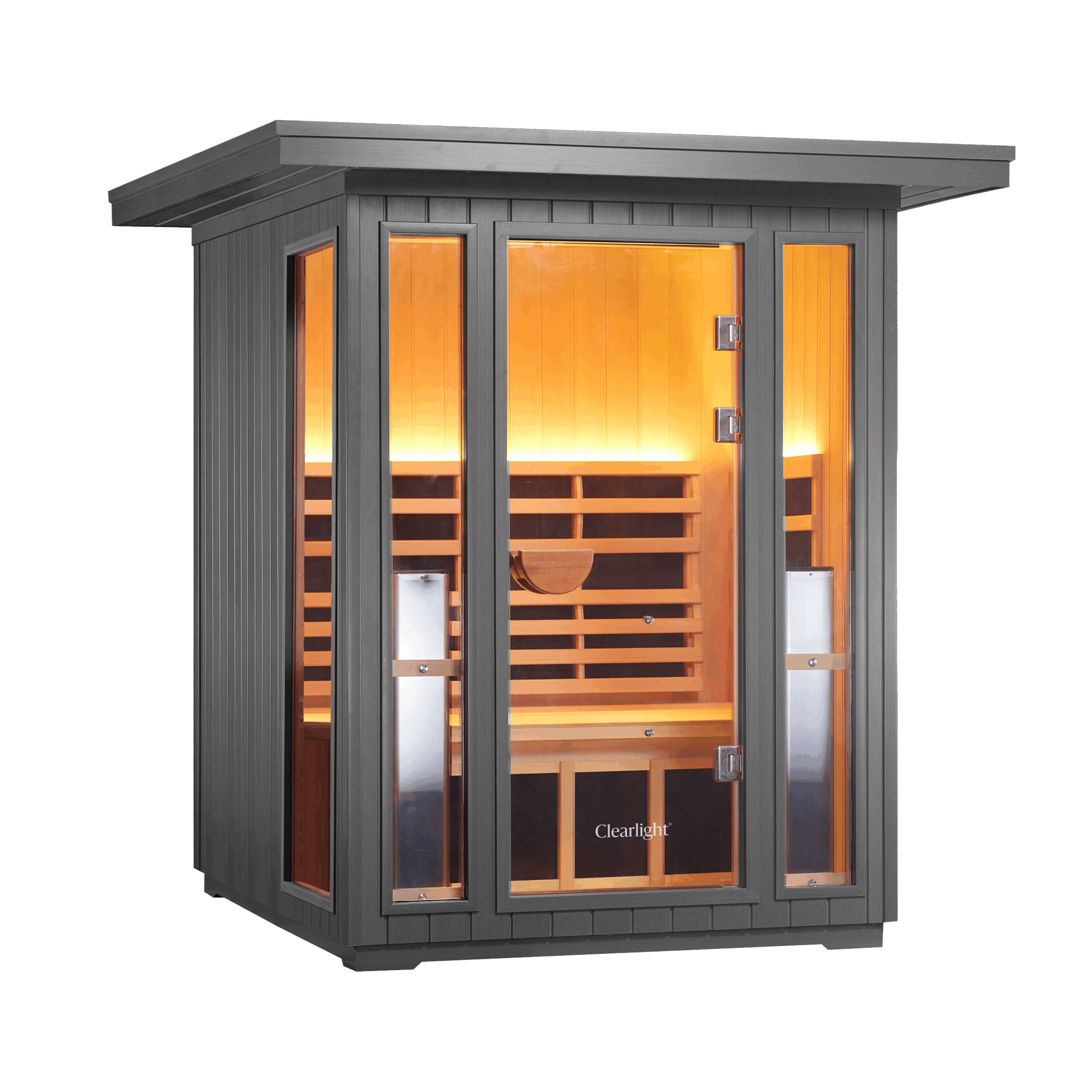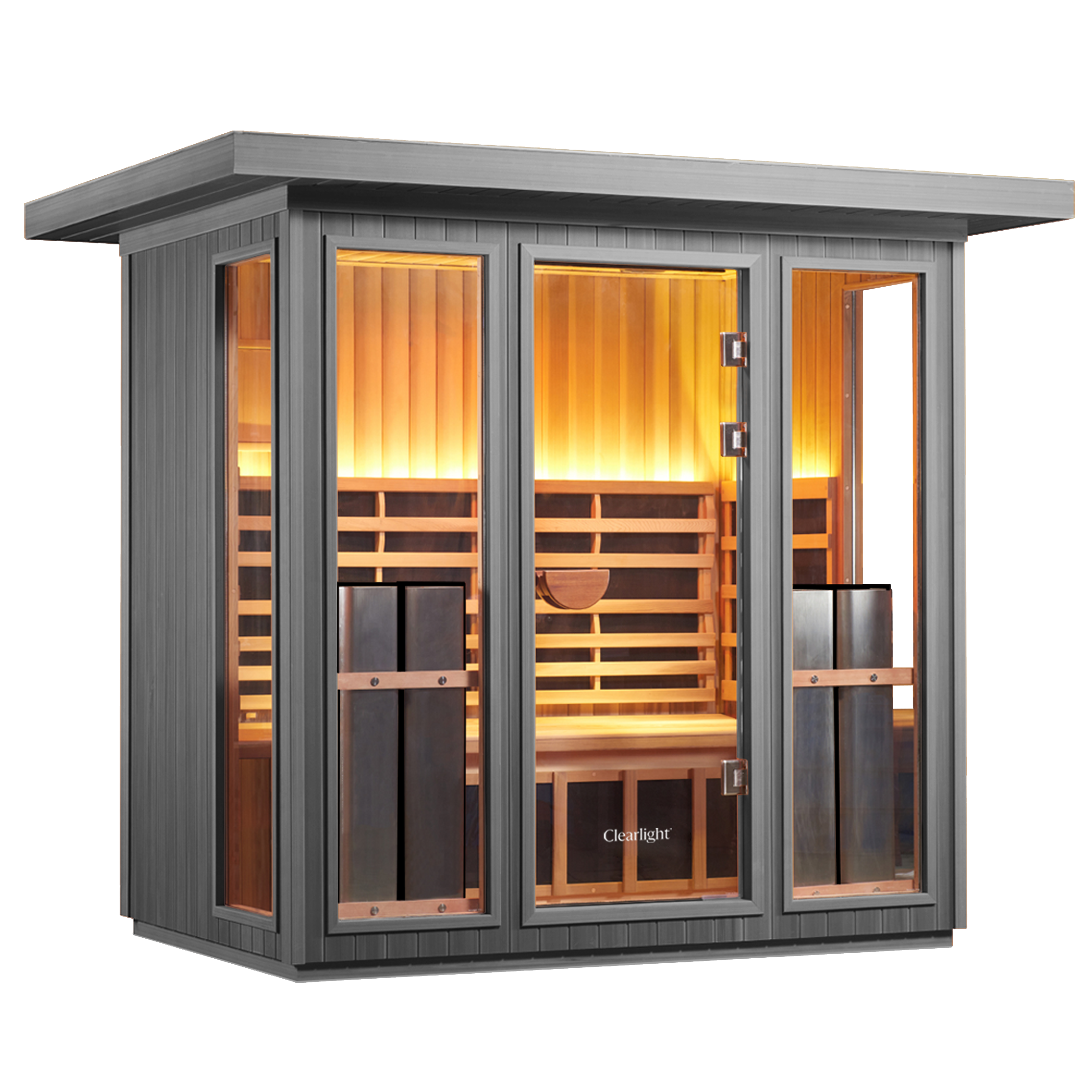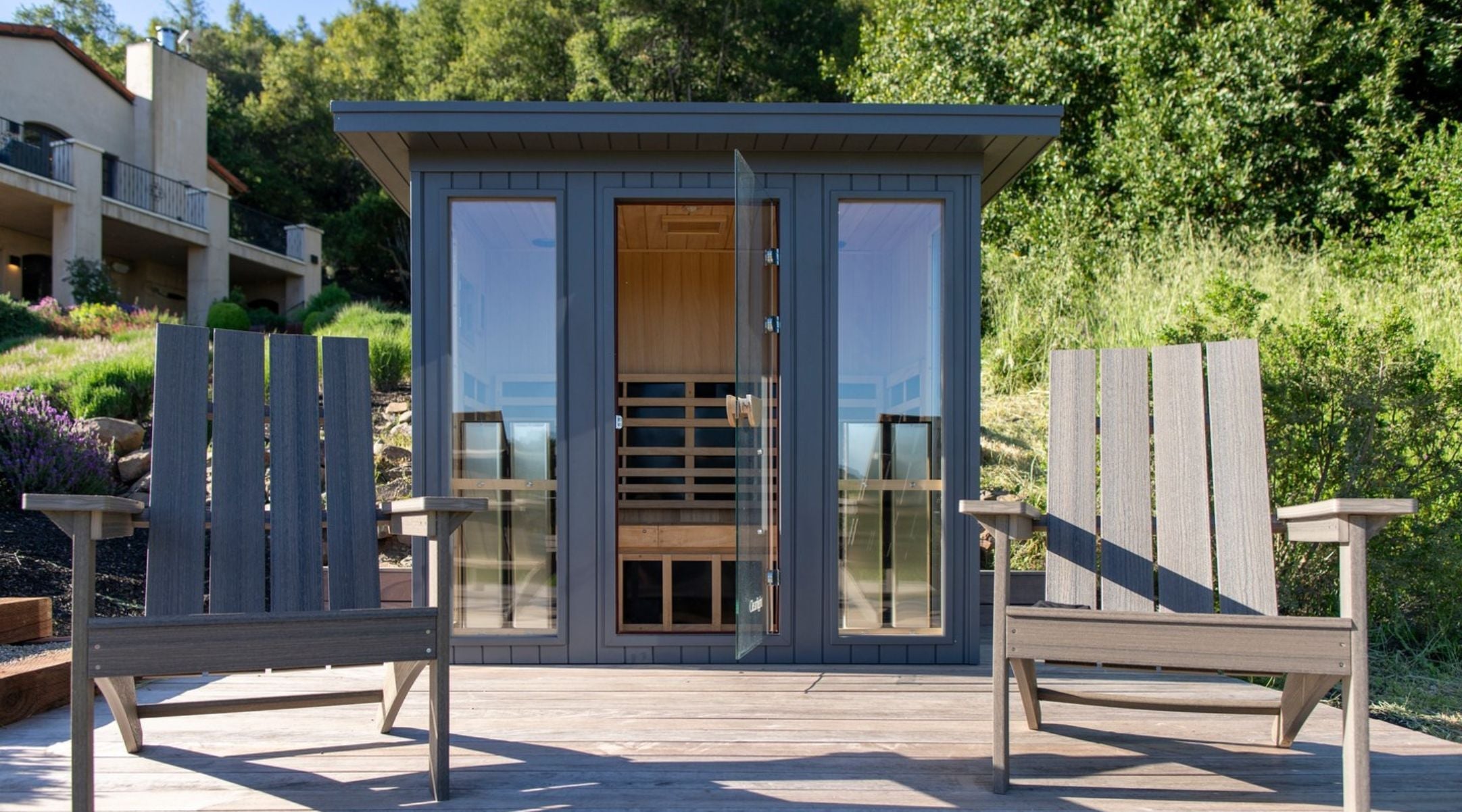

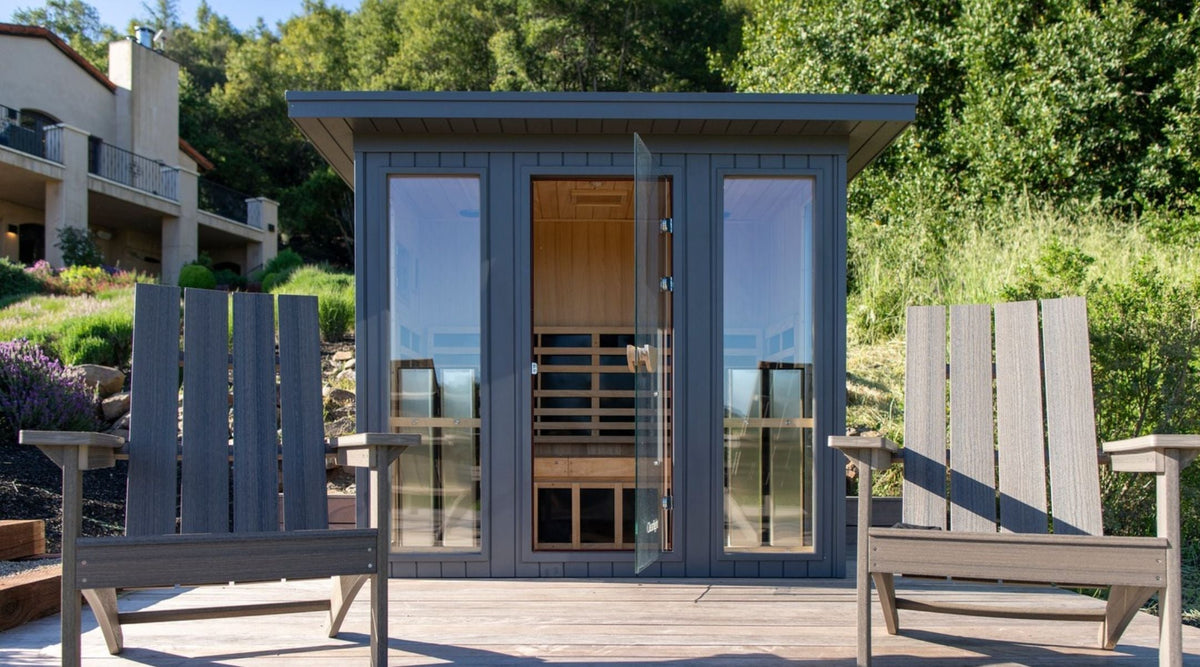
If you have been comparing outdoor sauna options, you have probably come across two very different approaches: the high heat of a traditional Finnish sauna, often found in a classic cabin or barrel sauna, and the lower temperature of an outdoor infrared sauna. Both create a powerful heat experience and can increase skin temperature, sweating, heart rate and peripheral circulation, but they achieve it in fundamentally different ways.
A traditional sauna heats the air around you, typically using an electric or wood fired heater and heated stones. The result is the intense, enveloping heat associated with the classic Finnish sauna experience, with temperatures commonly reaching around 77-93°C. Water can also be poured over the stones to create bursts of steam, increasing the humidity and changing the way the heat feels on the skin.
An infrared sauna takes a different approach. Rather than relying primarily on heated air, infrared heaters emit infrared energy that is absorbed by the body and converted into heat, allowing the sauna to operate at a considerably lower ambient temperature, typically around 46-54°C. The experience is less about heating the entire room to an extreme temperature and more about creating a direct, sustained heat stimulus for the body.
If you have experienced both types, the difference is immediately noticeable. A traditional sauna delivers the intense heat, steam and ritual that many people associate with a Finnish sauna, while infrared offers a gentler ambient temperature and a different style of heat that can be easier to incorporate into a regular routine.
So which is better? There is no universal answer. The right choice comes down to the type of experience you enjoy, how often you want to use your sauna, how you respond to high temperatures and what you want from your outdoor sauna. Understanding how each system works makes it much easier to compare the two and choose a model that genuinely suits the way you live.
Traditional vs infrared sauna: at a glance
| Traditional sauna | Infrared sauna | |
|---|---|---|
| How it heats | Heats the air and surrounding surfaces | Uses infrared energy to warm the body directly |
| Typical temperature | Around 77-93°C | Around 46-54°C |
| Heat source | Electric heater and hot rocks | Infrared heating panels |
| Steam | Yes, when water is added to the rocks | No |
| Heat-up time | Generally longer | Generally faster |
| Energy use | Higher | Generally lower |
| Experience | High-temperature, intense heat | Lower-temperature radiant heat |
| Session style | Often shorter and more intense | Often longer and more comfortable |
| Best suited to | Those who enjoy the higher heat sauna experience | Those looking for regular, lower-temperature heat sessions |
How does a traditional sauna work?
A traditional sauna heats the air inside the cabin using an electric or wood-fired heater, with stones positioned over the heat source to absorb and radiate heat throughout the room. When water is poured over the hot stones, it evaporates into steam, temporarily increasing humidity and creating the characteristic intense heat associated with the traditional sauna experience.
The high ambient temperature is central to how a traditional sauna works. Rather than directly heating the body with a particular wavelength of energy, the body is exposed to a very hot surrounding environment, causing skin temperature and core temperature to rise and prompting physiological responses such as increased blood flow to the skin, sweating and an elevated heart rate.

For people who enjoy that sensation, the intensity is part of the appeal. A traditional sauna can feel deeply immersive, particularly when combined with the ritual of heating the stones, adding water and moving between periods of heat and cooling.
The trade-off is that the environment can be physically demanding. Temperatures approaching 90°C are significantly hotter than normal body temperature, and many people will naturally prefer shorter periods of exposure rather than spending extended periods in that environment.
Traditional saunas can also require considerable preparation time, as the stones and cabin need to reach their operating temperature before the sauna is ready for a session. Depending on the size and design of the sauna, this can mean waiting 30-45 minutes or longer.
How does an infrared sauna work?
Infrared saunas use infrared radiation rather than primarily relying on heated air to create the sauna experience. Infrared is a form of electromagnetic radiation that sits beyond the visible light spectrum, and different wavelengths interact with materials, including the human body, in different ways.
Instead of heating the entire cabin to extreme temperatures, infrared heaters emit radiant energy that is absorbed by the body, allowing the sauna to operate at a considerably lower ambient temperature while still creating a meaningful heating and sweating response.
This is the fundamental difference between the two technologies.
Traditional sauna heats the environment around you. Infrared sauna uses radiant energy to heat you more directly.
 Clearlight's TrueWave® carbon/ceramic heaters are designed to operate across the near, mid and far infrared ranges, with the system performing optimally within approximately 6–12 microns and significant output around 9.4 microns. These wavelengths sit within the infrared portion of the electromagnetic spectrum that is relevant to radiant heat transfer and are selected to create a broad-spectrum infrared experience rather than relying on a single narrow band.
The result is a different kind of heat: less about making the room extremely hot and more about delivering infrared energy to the body at a temperature that many people find considerably easier to tolerate.
Infrared vs traditional sauna: what's the difference in heat?
The most immediately noticeable difference is temperature.
A traditional sauna commonly operates around 77-93°C, while an infrared sauna generally operates around 46-54°C. That difference of more than 10°C can dramatically change how a session feels.
Traditional sauna heat is transferred to the body primarily through the hot air and surfaces within the cabin, while infrared radiation can transfer energy directly to the body without first needing to raise the temperature of the surrounding air to the same degree.

This doesn't mean that infrared heat is simply a weaker version of traditional sauna heat. It is a different method of heat delivery, and the lower ambient temperature can make infrared particularly appealing to people who want to incorporate sauna into their routine without having to tolerate an extremely hot environment.
For some people, that distinction is the difference between using a sauna occasionally and using one several times a week.
How deeply does infrared heat penetrate?
Infrared radiation does not simply sit on the surface of the skin, but the depth to which different wavelengths penetrate depends on the wavelength, tissue composition and the properties of the radiation itself. Near-infrared wavelengths generally have greater optical penetration than longer infrared wavelengths, while far-infrared energy is absorbed more superficially.
This is why claims that all infrared heat uniformly penetrates a specific depth should be treated carefully.
What is well established is that infrared radiation can be absorbed by biological tissues and converted into heat, contributing to the body's overall thermal load. The resulting increase in tissue and skin temperature can promote physiological responses including vasodilation, increased skin blood flow and sweating.
Clearlight's approach is to use a broad range of infrared wavelengths rather than relying on a single wavelength, with TrueWave® carbon/ceramic heaters operating across approximately 6–12 microns and significant output around 9.4 microns.
The goal is not simply to make the sauna hotter. It is to deliver infrared energy efficiently while maintaining a more comfortable ambient temperature.
Why does infrared feel different?
Because an infrared sauna does not need to heat the surrounding air to the same extreme temperature, the experience can feel considerably less oppressive than a traditional sauna.
You can still sweat heavily, your skin temperature rises and your body responds to the heat, but you are not sitting in an environment approaching 95°C.

For people using sauna as part of a regular wellness or recovery routine, this can be an important practical advantage. A session that feels manageable at 46-54°C is easier to incorporate into a normal day, whether that means using the sauna after exercise, in the evening or as part of a consistent recovery routine.
In other words, the benefit isn't necessarily about tolerating more heat; it is about making therapeutic heat easier to use consistently.
How quickly does an infrared sauna heat up?
Another practical difference is how quickly each type of sauna is ready to use.
Traditional saunas need to heat the rocks, air and surrounding surfaces before they reach their intended operating temperature, which can take 30–45 minutes depending on the sauna and environmental conditions.
Infrared saunas do not need to bring the entire cabin to an extremely high temperature before the infrared heaters can begin delivering radiant energy. You can therefore begin experiencing the heat much sooner, although the precise warm-up time varies by model, ambient temperature and desired session temperature.
For anyone who wants to use their sauna regularly, this can make a surprising difference. A sauna that requires substantial preparation can become something you use when you have plenty of time; a sauna that is ready more quickly can become part of an everyday routine.
Which uses less energy: infrared or traditional sauna?
Energy consumption is another important consideration, particularly when choosing an outdoor sauna that you intend to use frequently.
Traditional saunas need to heat a significant volume of air, as well as the stones and internal surfaces, to temperatures that can approach 95°C. Infrared saunas operate at considerably lower ambient temperatures and use radiant heating technology, which generally means less energy is required to create the desired heating experience.
Clearlight estimates that its infrared saunas can use up to 90% less energy than traditional saunas, although actual energy consumption will vary according to the sauna model, session length, ambient temperature, electrical supply and frequency of use.
The distinction becomes particularly relevant when you consider the sauna as something you want to use several times a week rather than occasionally. Lower energy consumption can make frequent sessions more practical, while also reducing the ongoing operating cost of the sauna.
Infrared sauna and recovery
Heat exposure has been studied extensively for its effects on the cardiovascular and circulatory systems. When the body is exposed to heat, blood vessels in the skin dilate, blood flow increases and the cardiovascular system works harder to regulate body temperature. Sweating then helps dissipate heat through evaporation.
These responses are part of the reason sauna bathing has attracted considerable interest in the fields of cardiovascular health, exercise recovery and general wellbeing.
Infrared sauna provides those heat-related responses without requiring the same extreme ambient temperatures as a traditional sauna.

For recovery, that can make infrared particularly appealing. A lower-temperature environment may allow a person to spend more time in the sauna without the experience becoming overwhelmingly intense, although the ideal session length will always depend on the individual and their tolerance to heat.
Clearlight's full-spectrum TrueWave® heaters are designed to provide near, mid and far infrared wavelengths, giving the sauna a broad infrared output rather than relying on a single portion of the spectrum.
What does full-spectrum infrared mean?
Not all infrared saunas use the same type of infrared technology.
The term full spectrum generally refers to the use of multiple regions of the infrared spectrum, commonly described as near, mid and far infrared, rather than concentrating output in only one region.
Each wavelength interacts with matter differently, which is why wavelength matters when evaluating infrared heating technology.
Clearlight's TrueWave® carbon/ceramic heaters are engineered to provide full-spectrum infrared across these regions, operating within an approximate 6–12 micron range with significant output around 9.4 microns.
For consumers comparing infrared saunas, it is therefore worth looking beyond the words "full spectrum" on a product page and asking what the manufacturer's heaters actually produce, how the output has been measured and whether the claims are supported by independent testing.
What about EMF and ELF?
EMF and ELF are also important considerations when comparing infrared sauna systems.
Electrical equipment naturally produces electromagnetic fields, but the level and characteristics of those fields vary depending on the design of the electrical system and heating elements.

Clearlight's TrueWave® carbon/ceramic heating technology is engineered to produce ultra-low EMF and ELF, with Clearlight saunas independently tested for these emissions.
When comparing outdoor infrared saunas, it is worth asking whether EMF and ELF measurements are available, what distance they were measured at and whether the results come from independent testing rather than simply relying on a manufacturer's general claim.
Which is better for everyday use?
This ultimately comes down to the type of experience you want from your sauna and how you see yourself using it.
A traditional sauna can be an excellent choice if you love the classic Finnish sauna ritual, want very high temperatures, enjoy the sensation of hot rocks and steam, and prefer a shorter, more intense heat exposure. There is something distinctly immersive about stepping into a hot traditional sauna, particularly if you enjoy the ritual of building the heat, adding water to the stones and embracing the intensity.

An infrared sauna offers a different kind of experience. Operating at a lower ambient temperature, it creates a gentler, more comfortable heat that many people find easier to stay in for longer. Rather than feeling overwhelmed by the heat of the room, you can settle in, relax and allow your body to gradually warm and sweat. This makes infrared particularly appealing for regular use, whether that means a solo session after training, a longer session at the end of the day or simply spending time in the sauna with your partner or friends.
The lower temperature also changes the way the sauna can fit into your lifestyle. You can talk, read, listen to music or simply switch off without the same level of heat intensity, making the sauna feel less like something you need to endure and more like somewhere you actually want to spend time. With faster heat-up times and lower energy consumption, an infrared sauna can also be easier to use spontaneously, rather than requiring you to plan your session around heating the sauna for 30 to 45 minutes beforehand.
For an outdoor sauna, there is another consideration: how often will you realistically use it?
A premium sauna is a significant investment, so the best sauna is not necessarily the one capable of reaching the highest temperature. It is the one that fits naturally into your lifestyle, feels comfortable enough to use regularly and gives you an experience you genuinely look forward to. For many people, that combination of comfortable heat, a gradual sweat and a more relaxed environment is what makes infrared particularly well suited to everyday sauna use.
So, which outdoor sauna is right for you?
Traditional and infrared saunas both use heat to produce a physiological response, but they create that experience in fundamentally different ways.
Traditional sauna relies on high-temperature air, heated stones and, often, steam to create an intense environment. Infrared sauna uses radiant infrared energy to warm the body at a substantially lower ambient temperature, allowing for a different kind of heat experience that many people find easier to tolerate for longer sessions.

For those who enjoy the intensity and ritual of a traditional sauna, the classic approach remains compelling. But for people looking to make sauna part of a regular wellness, recovery or relaxation routine, the combination of lower temperatures, faster preparation, lower energy consumption and full-spectrum infrared technology can make an outdoor infrared sauna an appealing alternative.
Ultimately, the question isn't simply which sauna gets hotter?
It is which type of heat will you enjoy using often enough to become part of your life?